
Help center/Enforce your terms/Invoice late fees
How UK statutory interest and compensation fees work
Set up Paidnice to charge statutory interest at the Bank of England base rate plus 8% and the fixed £40, £70 or £100 compensation on late UK business invoices.
Updated 30 October 2026
In the UK, the Late Payment of Commercial Debts (Interest) Act 1998 lets a business claim interest and a fixed compensation fee when another business pays an invoice late. Paidnice can work out both and create them in Xero or QuickBooks for you.
Paidnice does not give legal advice. Check your contract terms and the gov.uk guidance on late commercial payments before you charge, or ask your accountant or solicitor.
What the law allows
The Act covers business-to-business invoices only. It allows two charges:
- Statutory interest: the Bank of England base rate plus 8% a year, on the amount overdue. The base rate changes, so the total rate changes too. Turn on the Bank of England base rate in Paidnice (below) and you don’t need to edit the policy when the rate changes.
- Fixed compensation: a one-off amount per debt, set by its size.
| Debt | Compensation |
|---|---|
| Under £1,000 | £40 |
| £1,000 to £9,999.99 | £70 |
| £10,000 or more | £100 |
Do not set a higher rate than base rate plus 8% unless your contract with the customer allows it.
Setting up the interest
You can charge the interest with an invoice late fee or with a statement interest charge. Open a group, go to its Policies tab, and click Add Invoice Late Fee or Add Statement Interest Charge.
- Choose Interest Rate Per Annum.
- Turn on Apply the Bank of England base rate. This toggle only shows for UK organizations.
- Enter 8 in Percent Per Annum. The field then reads % + BoE rate annually.
- Set the Fee Income Account and the rest of the policy as usual.
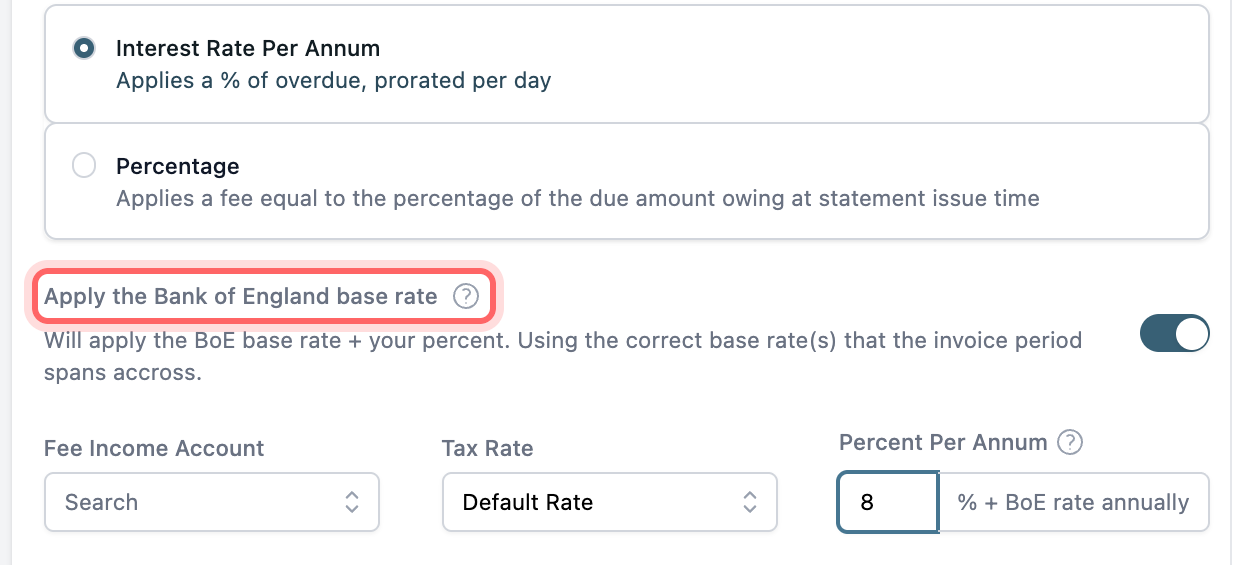
With the toggle on, you do not need to update the rate yourself when the Bank of England changes it. Paidnice adds each new base rate to its own list. It does not read the rate live from the Bank of England.
Paidnice always uses the base rate in force on each day. If an invoice stays overdue across a rate change, the interest line is split at the change, with each part at its own rate. Nothing locks the rate for a six-month period. The Late Payment Order fixes the rate for six months from 30 June and 31 December, so Paidnice’s figure can differ a little from the statutory method when the rate changes mid-period.
Turn off interest on interest
On a statement interest charge, Include previous interest charges is on by default. That adds every invoice Paidnice created to the balance, including earlier interest invoices and the £40, £70 and £100 compensation invoices. Left on, the customer pays interest on interest and interest on the compensation. Turn it off if you want simple interest on the original debt only. Invoice late fees never charge a fee on a fee invoice.
Setting up the compensation
Add three invoice late fee policies, one for each band. In each one:
- Choose Fixed and enter the amount: 40, 70 or 100.
- Leave Repeat Late Fee off, so each invoice is charged once.
- On the More Options & Filters tab, add Minimum Due Amount and Maximum Due Amount for the band.
| Policy | Minimum Due Amount | Maximum Due Amount |
|---|---|---|
| £40 | 0 | 999.99 |
| £70 | 999.99 | 9,999.99 |
| £100 | 9,999.99 | Leave empty |
The minimum is exclusive and the maximum is inclusive. An invoice is skipped when its amount due is equal to or below the minimum. So a minimum of 1,000 would skip an invoice with exactly £1,000 due, and that is why the table uses 999.99 and 9,999.99.
Both amounts are compared with the invoice’s current amount due, in the invoice’s own currency. A part-paid invoice can fall into a lower band than its original total. The fixed amount is also in the invoice’s currency.
Don’t add First time only to the compensation policies. It skips an invoice that any other late fee policy has already charged, including your interest policy, so it can stop the compensation being charged at all.
Invoice late fee or statement interest
Use an invoice late fee if you want each overdue invoice to carry its own interest charge. Use statement interest if you want one interest invoice per customer per currency, each month or each week, that covers everything overdue. Pick one for the interest in each group, or the customer can be charged interest twice. The compensation fees are always invoice late fees, so a group with statement interest and compensation shows the duplicate fees warning even though the charges cover different things. See How invoice late fees work and How statement interest charges work.